The inside story of the Markes TC-30 tube conditioner
24 March 2026

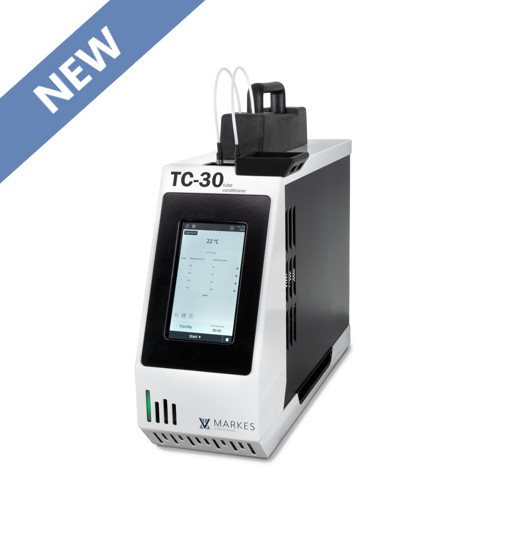
In thermal desorption–GC–MS, conditioning sampling tools, such as sorbent tubes, to ensure a clean background is critical for protecting sample integrity. Markes’ new 30-tube conditioner makes that process more intuitive, while delivering faster workflows and maximising lab productivity.
We spoke with Product Manager Jess Berger to get the inside story on the TC-30.
What can you tell us about the new TC-30™ sorbent tube conditioner?
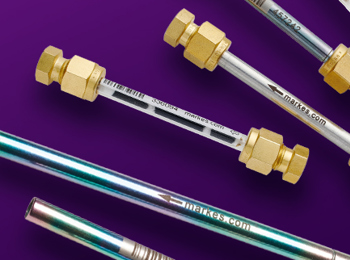
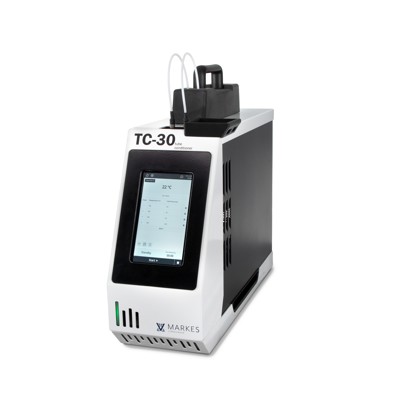 Well, it all relates to clean sorbent tubes (or other tube-compatible sampling tools like HiSorb probes). Many of our customers will know the Markes TC-20 tube conditioner, a trusted workhorse that has earned its place in busy labs around the world. Without it, sample analysis stops as the TD system is busy conditioning tubes one by one. You could say the TC-30 is a next-generation product. Like the TC-20, it frees up instrument time to run analytical samples, saving time and cost, but we’ve designed and built it from the ground up to do so much more than its predecessor.
Can you tell us what new features were on your radar?
In the design phase, we consulted with customers to fully understand their challenges - what they liked about the TC-20, and what was on their wish list. The stand-out request was a need for unattended (programmable) operation. Firstly, could they load tubes at the end of the day and return in the morning with everything done, ready for sampling, while minimising carrier gas use? The TC-30’s timed start function does just that. Secondly, for lengthy conditioning methods with multiple temperature ramps and hold times, could this be fully automated in a single, programmable sequence for a truly hands-free workflow? The TC-30’s intuitive touchscreen and built-in methods allow exactly that. We also knew that customers use their TC-20 for dry-purging multiple tubes, to stop unwanted moisture getting to the GC column and detector. The TC-30 includes a dedicated dry-purge method.
And why specifically the 30-tube capacity?
There's actually a lot more to settling on that particular number! Contract and research laboratories can be handling hundreds of tubes per day, so more capacity is always attractive. But capacity has to be balanced against power consumption. Thirty tubes turns out to be the sweet spot, significantly increasing throughput without excessive energy demand or engineering complexity. With the higher capacity of the TC-30, we’ve estimated that if you’re running a one hour-method, up to 270 tubes can be conditioned per day.
The TC-30 is a next-generation product - we’ve designed and built it from the ground up to do so much more than the TC-20
Why were these features prioritised for your customers?
Compared to the Markes TC-20, the TC-30 introduces full programmable control, higher capacity and a touchscreen interface. With the TC-20, operators had to return to the lab each time the temperature needed to be increased, manually pressing a button to move to the next step. The TC-30 automatically manages every temperature, ramp and hold, and alerts you when the cycle is complete. So, if you're using Markes’ Universal tubes, you simply select the method, it is pre-loaded and ready to go. For anything custom, whether that's a specialist tube type or a specific conditioning protocol, you set your parameters and save as a favourite for next time. You get unlimited methods, all stored on the device. As one of our testers put it: "I’ll be doing less steps per day but will get more done!"
Is it aimed just at high throughput lab users?
Not at all. The TC-30 is really for any lab that understands the value of sampling with clean tubes, especially where sensitivity is critical for confident trace-level detection. Even the smallest amount of contamination can mean reworking the samples, which can be costly and time-consuming.
In terms of productivity, high-throughput contract labs will benefit most visibly but the same logic applies for smaller labs. The TC-30 can operate in smaller batches of 15 tubes. You simply detach one of the two push-fit gas connectors from the unused side of the manifold.
There's also sustainability built in. Conditioning tubes off-line on the TC-30 instead of your analytical instrument means you can use nitrogen (fully renewable) rather than helium (finite). Markes thermal desorbers are multi-gas, meaning they can also run on nitrogen, but you still don’t want to tie up your analytical instrument.
The TC-30 comes pre-loaded with methods for Markes tubes of all types. But it’s worth noting that it's fully compatible with tubes from other manufacturers, such as Gerstel mini-tubes. In fact, many sampling tools that fit into a tube are compatible, so analysts using HiSorb probes, Twister stir bars, radiello cartridges or thin-film microextraction-based workflows can set up custom conditioning methods for these, simply by saving the appropriate temperature and parameters as a named method.
Can you tell us about any of the design decisions made along the way?
The TC-30 has been many years in the making, with Engineering, Design, Manufacturing, Marketing and other teams all involved at various stages. One of the big factors was that in some cases, you're heating up to 425°C, and you've got sensitive electronics living in the same unit. So, we used the space carefully in an optimised design. Another example was tilting the touchscreen slightly upwards to improve visibility.
The touchscreen interface is designed for quick setup; in just a few clicks, tubes start conditioning and the analyst can move onto other important daily tasks. It also unlocks things that just wouldn't be possible otherwise, like multi-language support. Customers can choose from English, Chinese, German, Spanish and more. You’ll also find on-screen walkthroughs of tasks like changing an O-ring, helping users complete maintenance more efficiently. And yes, we tested the screen works with lab gloves on.
There are a lot of features! What else do you feel is important to mention?
There are a few things that matter a lot in practice. Password protection is one. You can lock in methods as read-only so technicians can't accidentally set the wrong temperature or overwrite a validated protocol. In a busy lab with multiple users, that's an important safeguard. Another is the low-pressure warning. If the TC-30 does not detect carrier gas flow or it is too low, it will not heat the tubes. Heating sorbents with no gas flow can permanently damage them. This can occur when the gas cylinder has run out or when an operator forgets to turn the gas flow on. That’s why we designed a fail-safe into the TC-30 which prevents this accidental damage to the tubes.
We also thought about portability. Not only can the system be set up and connected wherever a gas supply and mains power are available, but labs do reorganise and instruments get moved, so we added hand-holds to make the TC-30 easier to lift and reposition. One other point is that the team added a coaster for the manifold, making it easier to load tubes.
Looks like the TC-30 is well placed for the future; how easy is it to maintain?
Getting up and running only requires a clean gas supply and a power source; no engineer visit is needed. After that, it just gets on with the job. It lets you set a maintenance reminder, typically every twelve months for a filter change, and will flag when it's next due. Software updates are handled via USB. The idea is that the TC-30 looks after itself, so you can focus on your analysis.
In summary, it all starts with clean tubes…. You can have the best analytical instrument in the world, the best GC–MS setup, but if your sampling tools aren't clean, you're compromising everything that follows.